ORCHESTRATION
Full analysis lockedConnected systems beat isolated automation.
Where value appears when robots, data and decisions become one production system.
IMTS showed thousands of machines. We filtered the show into five management signals that affect investment, implementation and the next factory decision.
Each takeaway explains what changed, why it matters to management and what should happen next. Submit your business email below to read the complete material on this page and download the executive brief.
Enter your business email to unlock the full on-page analysis and download the PDF immediately. The brief includes sourced show-floor signals, a decision test for each trend and practical next steps.
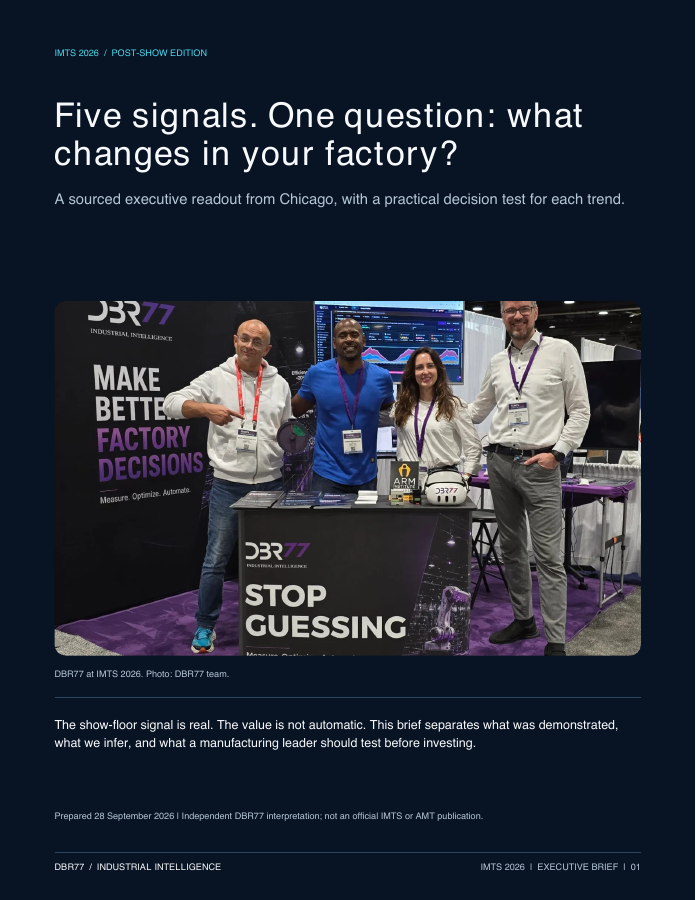
The new 9-page PDF brings together five sourced signals from the show, the management implications and a practical decision test for each one.
↓ Download the 9-page PDFIMTS still delivers an extraordinary concentration of individual technologies: robots, machine tools, vision, sensors, controls, software and AI. But the decisive shift was not the performance of one device. The stronger propositions showed how several layers cooperate—from the machine signal, through contextualized data, to a production decision and a measurable operational response.
An isolated robot may reduce manual work in one station. A connected production system can also expose the cause of waiting, identify unstable quality, coordinate material flow and change the next action taken by the operator or manager. That difference determines whether an investment remains a local productivity project or becomes part of a scalable operating model.
Stop evaluating technologies only as separate purchases. Every investment should declare what it connects to, which information it exchanges, who owns the resulting decision and how the system behaves when the data or equipment is unavailable.
The most credible AI demonstrations were not generic assistants promising to understand the entire factory. They were narrower capabilities embedded in tools people already use: support for programming, setup, inspection, fault diagnosis, maintenance, planning and knowledge retrieval.
This matters because value appears when AI shortens a real task, improves a decision or preserves scarce expertise. A standalone interface creates curiosity. An embedded capability can reduce troubleshooting time, help an engineer compare alternatives or give an operator the correct instruction at the moment of need.
The starting point should be a recurring workflow with a visible loss—not a general ambition to “implement AI.” The organization must also determine which decisions AI may recommend, which require human approval and how wrong answers will be detected.
Physical AI combines perception, reasoning and action in the physical environment. Humanoids, autonomous mobile robots, intelligent inspection and adaptive automation make the concept visible. Yet a compelling demonstration does not prove that a system can deliver safely and reliably inside an operating plant.
Production readiness depends on less spectacular elements: data quality, cycle stability, safety validation, exception handling, OT/IT integration, maintenance, ownership and employee trust. These conditions often determine more of the business case than the headline capability of the machine itself.
A pilot must be designed as an evidence project. Before purchase or deployment, the team should define the baseline, required utilization, allowed failure modes, integration boundaries, acceptance criteria and the person accountable after the integrator leaves.
Automation discussions often begin with a preferred technology. The stronger investment logic at IMTS began with a constraint: lost capacity, unstable quality, unsafe work, excessive changeover, unavailable skills or a recurring delay that prevents the process from meeting demand.
This sequence matters because the correct answer may be an industrial robot, a cobot, better sensing, redesigned material flow, improved work instructions or no new automation at all. A technically impressive solution can still destroy value if it automates the wrong step, creates new waiting or requires expensive support.
ROI should include more than labor substitution and nominal cycle time. It should expose integration, ramp-up, downtime, changeovers, maintenance, training, flexibility and the financial value of quality or additional capacity.
Greater autonomy changes human work; it does not remove human responsibility. Someone still defines the objective, validates exceptions, maintains the system, interprets uncertainty and decides what happens when the model, machine or process behaves differently than expected.
Many transformation projects underperform because adoption is treated as communication after the technical work is complete. In reality, operating routines, escalation rules, skills and feedback loops must be designed together with the technology. Otherwise the new system remains optional, is bypassed under pressure or creates a second unofficial process.
The operating model is part of the technical scope. Leaders should be able to name the process owner, daily users, decision rights, required capabilities, escalation path and the measures that confirm the new behavior is actually being used.
Join the live IEX program or continue with practical manufacturing conversations on Spotify.
Sources: AMT post-show release, IMTS on connected automation, IMTS on Industrial AI and IMTS on automation ROI. Independent DBR77 analysis; not an official IMTS or AMT publication.